 |
|
|
|
||||||||||
|
|
Barra Fort A chapel dedicated to St. James (S. Tiago), a patron saint of the military, was built in 1740. According to legend, the saint's statue would patrol the fort at night and have mud on his boots in the morning. A soldier was thus detailed to clean them. At one time the soldier had failed to fulfill his obligation, and was therefore hit on the head by St. James' sword. After World War II, the cannons were sold for rice to feed refugees from Hong Kong and China. Throughout the years, the fort was perceptibly demolished to build roads, and was finally abandoned by the Marine Police in 1976. Today, the fort is one of the city's major attractions after the Macau Government Tourist Office converted the ruins into a Portuguese Inn. Kung Iam Temple In adjoining rooms are funeral chapels and scrolls honoring the deity in pictures and calligraphy. At the back of the temple are gardens, one of which lays a historic stone table where the first Sino-American treaty was signed on July 3, 1844 by the Viceroy of Canton, Ki Ying, and the United States Minister, Caleb Cushing. Adjacent is a marble statue of a monk in an ornate pavilion and four banyan trees with braided branches, which is known as the Lover's Tree and a symbol of martial fidelity. Other features of the gardens are the fountains in miniature Chinese landscapes, groves of bamboo, and small shrines of departed priests. The Kung Iam festival is celebrated on the 19th day of the second, sixth, ninth, and eleventh moon.
|
|
BROWSE Home
l Places
of Interest l Outdoor
Travel l Food
in Asia l General
Info l Entertainment DESTINATIONS Australia
l Bali
l Brunei
l China
l Hong
Kong l Japan
l Korea
l Macau
l Malaysia
l Myanmar
l New
Zealand Copyright © by Hotnet Sdn.Bhd. ALL RIGHTS RESERVED |










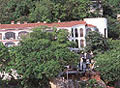 The
fort, which was completed in 1629, was a protection area for the bar at
the entrance to the Inner Harbour against the Dutch in 1622. The fort
was a small town, built into the hills on the tip of the peninsula. The
30-feet chumanbo walls, rising from stone foundations, were 19 feet thick
at the base and 11 feet at the top. The main platform was wide and was
supported by 12 cannons of 24-pound caliber and four 50-pounders, a water
cistern with 3,000-ton capacity and quarters for the commander and his
60 soldiers. Further up the hill was a guardhouse and six 24-pound cannons,
while at ground level were stores for ammunitions and supplies, as well
as a large house.
The
fort, which was completed in 1629, was a protection area for the bar at
the entrance to the Inner Harbour against the Dutch in 1622. The fort
was a small town, built into the hills on the tip of the peninsula. The
30-feet chumanbo walls, rising from stone foundations, were 19 feet thick
at the base and 11 feet at the top. The main platform was wide and was
supported by 12 cannons of 24-pound caliber and four 50-pounders, a water
cistern with 3,000-ton capacity and quarters for the commander and his
60 soldiers. Further up the hill was a guardhouse and six 24-pound cannons,
while at ground level were stores for ammunitions and supplies, as well
as a large house. 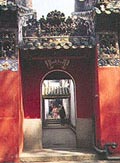 Dating
back to 1627, the Kung Iam temple is dedicated to the Goddess of Mercy.
It is one of the biggest and richest of Macau's temples with a massive
entrance gate and roofs clumped with porcelain figures. Separated by open
courtyards are richly decorated halls dedicated to the Precious Buddhas,
the Buddha of Longevity and Kung Iam. The latter is dressed in embroidered
silk with a fringed crown, which is changed every year. Eighteen Buddhas
attend Kung Iam on either side of the altar.
Dating
back to 1627, the Kung Iam temple is dedicated to the Goddess of Mercy.
It is one of the biggest and richest of Macau's temples with a massive
entrance gate and roofs clumped with porcelain figures. Separated by open
courtyards are richly decorated halls dedicated to the Precious Buddhas,
the Buddha of Longevity and Kung Iam. The latter is dressed in embroidered
silk with a fringed crown, which is changed every year. Eighteen Buddhas
attend Kung Iam on either side of the altar.